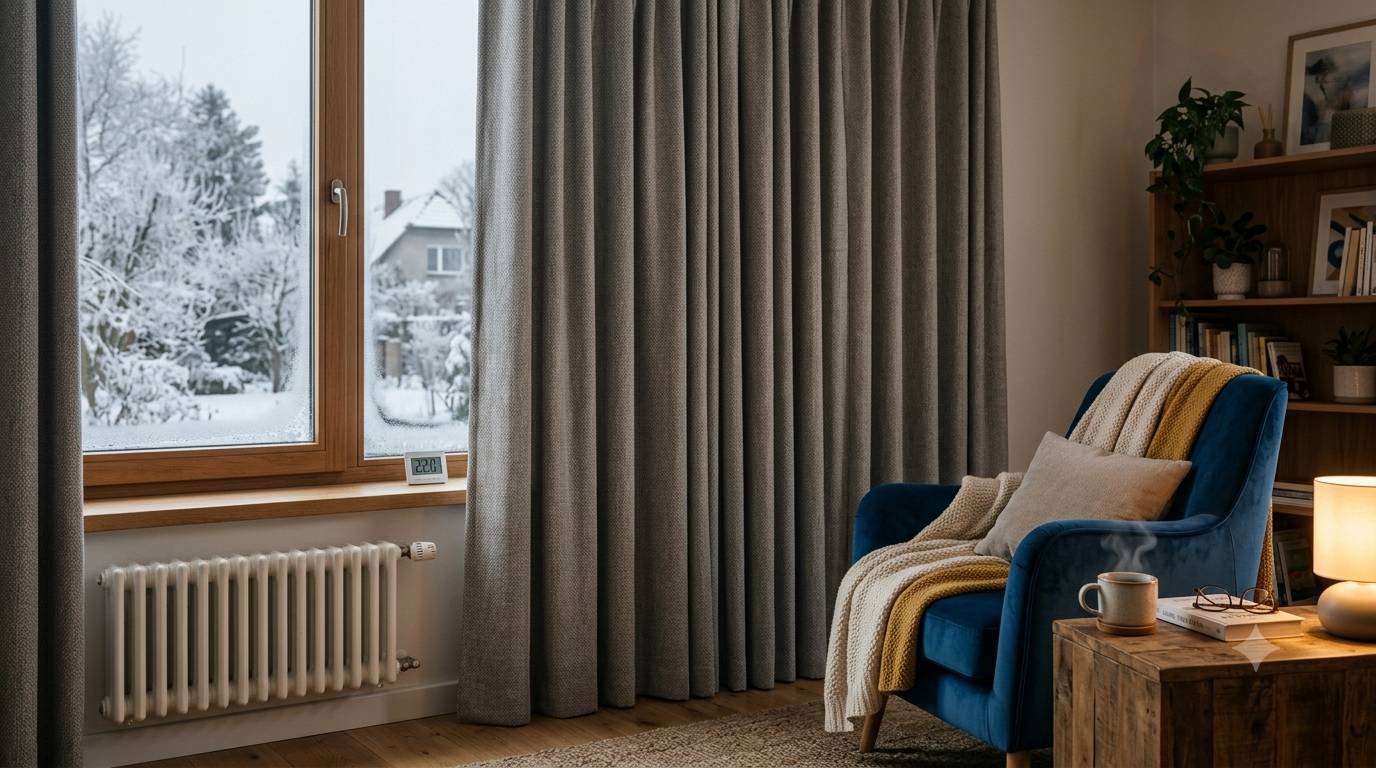
Ofgem confirmed on 26 August that the energy price cap rises four per cent on 1 October, taking a typical dual-fuel bill to £1,723 a year. Almost all of that sits on gas, up around eight per cent, so it lands hardest on households about to switch the boiler back on. Attention has duly returned to the cheap end of the retrofit ladder, where window coverings sit near the top of the list.
It is a reasonable place to look. Heat loss through windows has accounted for roughly a fifth of the heat lost from British homes for the past half century, and unlike a new boiler or wall insulation, a curtain can be closed tonight. What is less reasonable is the advice, which puts the saving at anything from a few per cent to almost half.
That spread is not the invention of marketing departments. It comes from the research itself. Two of the most widely cited British studies were run at the same university, by the same lead researcher, on comparable timber sash windows. One measured a 14 per cent reduction in heat loss. The other put it at around 40 per cent. For anyone weighing up energy efficient curtains as a winter measure, that discrepancy is the most useful thing to understand, because the explanation for it doubles as an instruction manual.
Why the same curtains behaved differently
The lower figure comes from Historic Scotland’s Technical Paper 1, published in 2008 after laboratory testing at Glasgow Caledonian University. The same series put timber shutters at a 51 per cent reduction, a Victorian roller blind at 28 per cent and secondary glazing at 63 per cent. A parallel English Heritage study, sharing an author and a laboratory, returned markedly higher numbers for the soft options.
The divergence sits almost entirely in those soft measures; the rigid ones agreed closely across both studies, which points straight at the mechanism. A curtain does not insulate the way loft insulation does. It holds a still layer of air against the glass, and that layer is only as good as its seal. A shutter seals by geometry. A curtain seals only if it has been hung to.
Where the performance is won or lost
Conservation guidance is unusually specific here, and little of it concerns fabric weight. Curtains need proper lining, ideally interlining, but they also need to overlap the opening on every side so the edges lie flat against the wall rather than floating in the reveal. The head detail matters most. If warm air pours over the top of a curtain it chills against the glass, sinks and spills back into the room at floor level, a convection loop that turns the window into a small radiator pointing outwards. A pelmet, or a heading tight against the soffit of a deep reveal, shuts it down.
Two details get missed routinely. Curtains that stop at a sill above a radiator send much of that radiator’s output straight into the glass, so either the curtain clears the radiator or it should not hang in front of one. And because the losses are largely radiant and bite hardest in the early evening, drawing curtains at dusk rather than at bedtime captures the part of the night that matters.
The comfort case is stronger than the bills case
The Glasgow Caledonian tests recorded something more persuasive than the percentages. The inner surface of the bare single glazing sat at roughly 12°C. With heavy curtains fitted, the room-facing surface rose to about 20°C, and the effective U-value fell from 5.4 to 3.2 W/m²K.
That eight-degree difference is what people in the room actually feel. Radiant loss towards a cold surface is why a room can hit its thermostat target and still feel draughty by the window, and the usual response is to turn the heating up. Removing that prompt delivers savings the heat flux figures never capture.
Curtains are not a substitute for glazing, draught-proofing or insulation, and they only earn their keep when closed. Draught-proofing the same test window cut air leakage by 86 per cent without improving its U-value at all, which is why sealing gaps usually belongs first in the queue.
The lesson of the conflicting figures is not that one study got it wrong. It is that curtains sit where a product becomes a system. The difference between 14 and 40 per cent is bought with fit, lining and a well-considered head, not with heavier cloth. Anyone choosing on fabric alone is optimising the one variable that matters least.